Riftbound Card Anatomy: What Every Number and Symbol Means
Every Riftbound card contains information that affects both how you play it and how you build your deck. Riftbound card anatomy is the term for every number, symbol, and text element printed on a card. Understanding it will help you read any card you pick up with confidence. Here is a breakdown of every component, by card type.

Page last updated: June 2026. Based on Unleashed (UNL) cards and the official Core Rules updated 30 March 2026.
This page breaks down every card type in Riftbound. Jump to the one you are holding, or scroll through from the top.
Jump to a card type:
Unit and Champion cards
Symbols and icons in the text box
Legend cards
Spell cards
Gear cards
Rune cards
Token cards
Buff cards
XP Tracker cards
Quick reference table
Unit and Champion Cards
Units are the fighters that go to Battlefields and deal damage in combat. Champion units are a specific subtype, identified by the word Champion printed before “Unit” on the type line. Both look the same and share the same card elements.

Energy Cost (upper left corner)
The large number in the upper left circle is the Energy Cost. This is how many Energy you need to play the card. Energy is a colourless resource generated by channelling runes from your Rune Deck.
Power Cost (below the Energy number)
Some cards have domain symbols stacked vertically below the Energy number. Each symbol means you need one Power of that domain to play the card. Not every card has a Power Cost. A card showing “4” with one green leaf below it costs 4 Energy and 1 Calm Power Rune.
Might (upper right corner)
The number in the upper right corner is the unit’s Might. This is its combat statistic: how much damage it deals when it fights, and how much damage it can take before being killed. If damage on a unit equals or exceeds its Might, that unit is killed. For a full explanation see How Damage Works in Riftbound.
Type Line
The banner below the illustration shows the card type and any supertypes or tags.
| What you see | What it means |
|---|---|
| Unit | A permanent card that stays on the board after being played. Goes to a Battlefield or your Base. |
| Champion | A supertype printed before “Unit.” Champion units are linked to a specific Legend and have deck-building restrictions (maximum 3 copies). |
| Tags | Words printed after the card type, such as KATARINA or NOXUS on the example above. Tags link Champion units to their Legend and can be referenced by card abilities. |
Name
The card name appears in the lower portion of the illustration area or on a name bar. Some cards have a subtitle below the name (for example, Katarina / RECKLESS). The full name including subtitle is used for deck-building rules.
Rules Text
The text box describes what the unit can do. It can contain any combination of the following:
| Element | What it looks like | What it means |
|---|---|---|
| Abilities | Standard sentences describing what the card does | Discrete effects the card has. A single card can have multiple abilities. |
| Keywords | Short bold or highlighted words: Deflect, Accelerate, Ambush, Hunt, TEMPORARY, REACTION, DEATHKNELL | A keyword is shorthand for a longer rule. See the Riftbound Keyword Index for the full meaning of every keyword. |
| Reminder Text | Italicised text in parentheses immediately after a keyword | A plain English summary of what the keyword means. No gameplay effect on its own. |
| Activated Abilities | Written as [Cost]: [Effect] | Abilities you choose to trigger by paying the listed cost. The colon separates cost from effect. |
Flavor Text
Some cards have italicised text in a shaded bar at the bottom of the text box. This is Flavor Text. It adds atmosphere and story context but has no effect on gameplay whatsoever.
Domain Symbols (lower right corner)
The symbols in the lower right corner show which Domains this card belongs to. You can only include cards whose domains match your chosen Legend’s Domain Identity. A card with no domain symbols can go in any deck.
| Domain | Colour | Symbol shape |
|---|---|---|
| Fury | Red | Circular symbol with three projecting points |
| Calm | Green | Leaf shape |
| Mind | Blue | Sun and moon combined |
| Body | Orange | Blocky diamond shape |
| Chaos | Purple | Hexagonal symbol with swirls |
| Order | Yellow | Angular winged symbol |
Collector Information (bottom strip)
The very bottom of the card shows the set code (UNL, ORI, SFD), the card number out of the total set size (for example, 023/219), a rarity symbol, and the card designer credit. None of this affects gameplay but it identifies exactly which printing you have. The set code and number are the most useful when looking cards up on TCGPlayer or other databases.
Symbols and Icons in the Text Box
Ability text uses symbols that appear as icons on the printed card. The most common ones you will see:
| Symbol | What it means |
|---|---|
| Exhaust | Turn this card sideways as part of paying the cost. An exhausted card cannot act until it readies at the start of your next turn. |
| Might | Refers to this unit’s current Might value. Appears in abilities that scale with how powerful the unit is. |
| Domain Power symbols | Each domain is represented by a unique icon used in cost boxes and ability costs. The six domains are Fury, Calm, Mind, Body, Chaos, and Order. |
| Universal Power | Power of any Domain. Can be paid using Power from any domain’s rune. |
| Keyword indicator | Appears after a keyword to show that what follows is modified by that keyword. Used with keywords like Level, Legion, Action, and Reaction. |
For a full reference of every symbol and icon used on Riftbound cards, see the Riftbound Icons page.
Legend Cards
Your Legend is your champion. You choose one before the game begins, place it in the Legend Zone, and it stays there for the whole game. Legends cannot be killed by normal gameplay. The collector info format at the bottom of a Legend card follows the same format as unit cards.

What is the same as a Unit card
Legends have the same Name, Type Line, Rules Text, Flavor Text, and Illustration as unit cards. The collector information at the bottom follows the same format.
What is different on a Legend card
| Element | How it appears on a Legend |
|---|---|
| No Cost box | Legends are not played from your hand. They start the game in the Legend Zone and have no Energy or Power cost. |
| No Might value | Legends have no Might number. They cannot be killed by damage and you do not attack directly with them. |
| Domain Identity | The domain symbols on your Legend appear prominently in the upper left area of the card (not the lower right corner as on units). These symbols determine which cards you can include in your entire deck. Every card in your Main Deck and Rune Deck must match your Legend’s Domain Identity. |
| Champion Tags | The tag(s) on your Legend’s type line link it to your Champion units. Any unit with a matching tag is that Legend’s Champion unit. |
| Activated Abilities with Exhaust cost | Many Legend abilities cost [E] (Exhaust) to use, meaning you turn the Legend sideways to pay. The Legend stays exhausted until the start of your next turn. |
Spell Cards
Spells are Main Deck cards that create an immediate effect and then go to the Trash. They do not stay on the board. The collector info format at the bottom of a Spell card follows the same format as unit cards.
| Card type | What happens when you play it | Stays on board? |
|---|---|---|
| Spell | Creates its effect immediately, then goes to the Trash. | No |
| Gear | Enters play at your Base as a permanent. Can be attached to a unit to grant it abilities. | Yes |
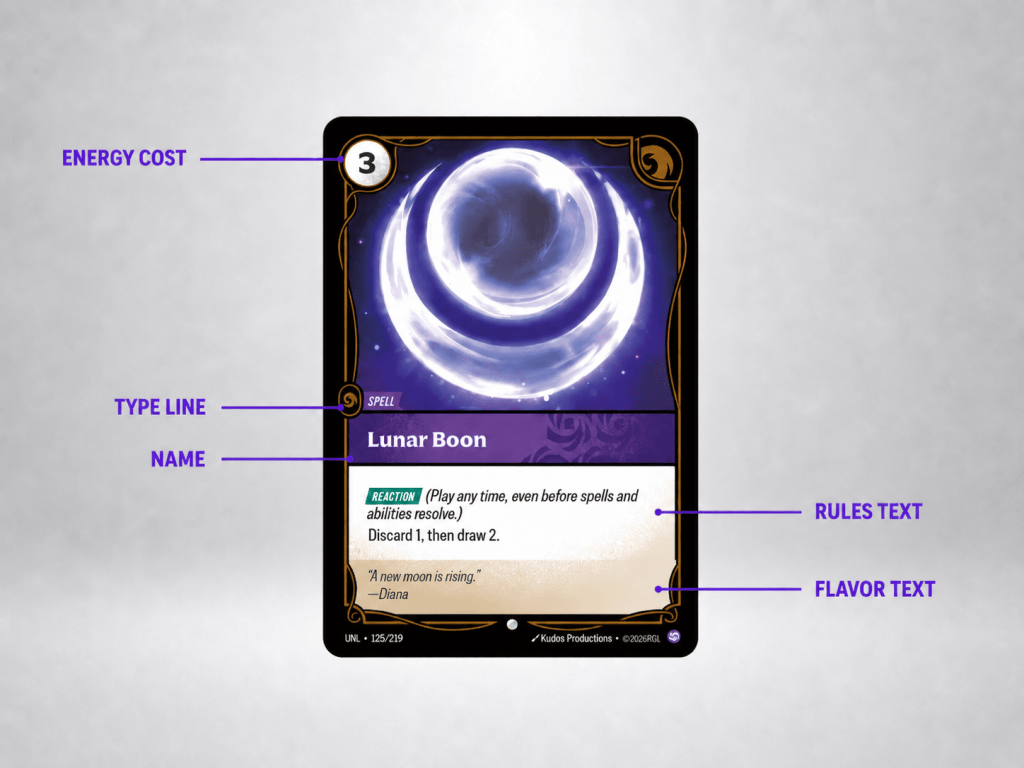
Spell card elements
Spell cards have the same Cost, Name, Type Line, Rules Text, Flavor Text, Domain Symbols, and Collector Info as unit cards. The key differences:
| Element | What it means on a Spell |
|---|---|
| No Might value | Spells have no Might. They are not units and cannot fight. |
| Self-reference | Spells use “this” to refer to themselves in card text, rather than “I” or “me” which units and legends use. |
| Signature supertype | Some Spells have “Signature” printed before “Spell” on the type line. Signature Spells are linked to a specific champion and have deck-building restrictions. |
Some Spell cards have keyword supertypes on the type line that affect when they can be played:
| Keyword | What it means for timing |
|---|---|
| Action | Can be played during your turn and during Showdowns (when both players can play spells in response to each other). |
| Reaction | Can be played during your turn, during Showdowns, and also during a Closed State. Reactions resolve before the spells and abilities already on the chain. |
Gear Cards
Gear cards are permanents. After being played they go to your Base and stay there. Gear can be attached to a unit, and while attached it grants that unit additional abilities. The collector info format at the bottom of a Gear card follows the same format as unit cards.
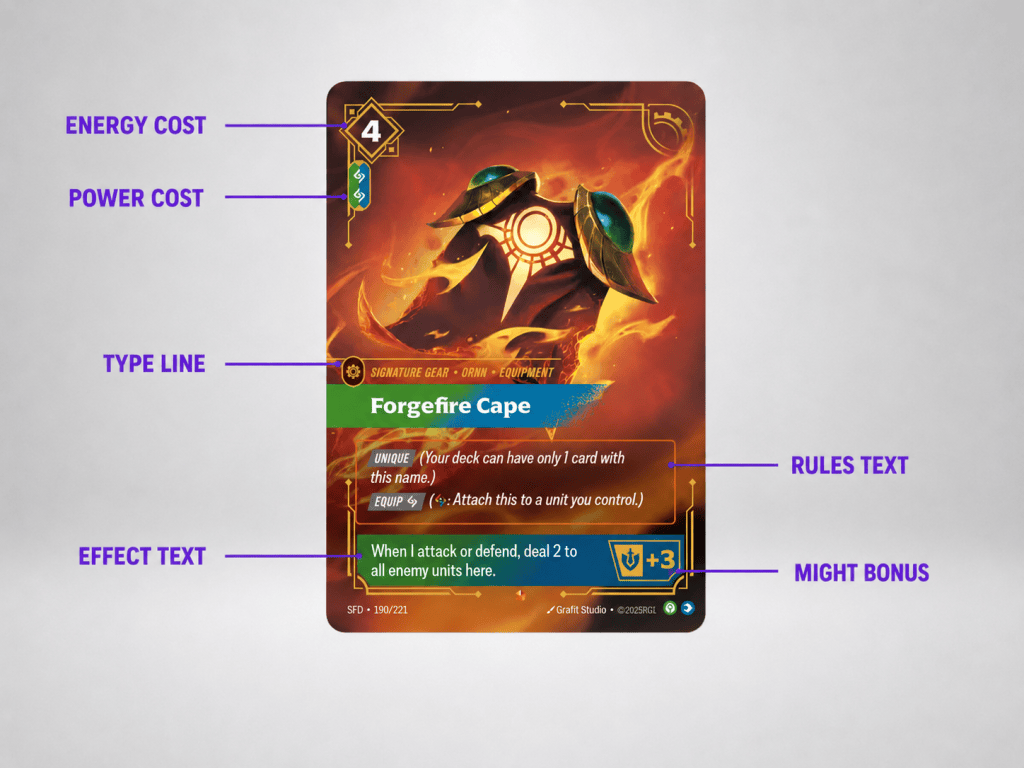
Gear card elements
Gear cards share all the same elements as Spell cards, plus two elements that only appear on Gear:
| Element | What it means | When it is active |
|---|---|---|
| Rules Text | The upper text block on a Gear card. Contains abilities that apply while the Gear is in play at your Base, such as UNIQUE (only one copy allowed in your deck) and EQUIP (the cost to attach it to a unit). | Always, while the Gear is in play |
| Effect Text | A visually separate block below the Rules Text, usually in a different coloured panel. These abilities are inactive while the Gear sits at your Base unattached. Once attached to a unit, the Effect Text becomes active and is treated as part of that unit’s Rules Text. | Only while Attached to a unit |
| Might Bonus | Shown as “+N” in the lower right corner (for example, +3 on Forgefire Cape). While this Gear is Attached to a unit, that number is added to the unit’s Might. If the unit has no Might value, the bonus is ignored. | Only while Attached to a unit |
Gear cards also use “this” to refer to themselves in card text. Like Spells, some Gear cards carry the Signature supertype, linking them to a specific champion.
Rune Cards
Runes live in your Rune Deck, a separate 12-card deck you build alongside your Main Deck. Runes are not played from your hand. They are channelled onto the board at the start of each turn to generate the Energy and Power you spend on everything else. The collector info at the bottom of a Rune card follows the same format as other cards.
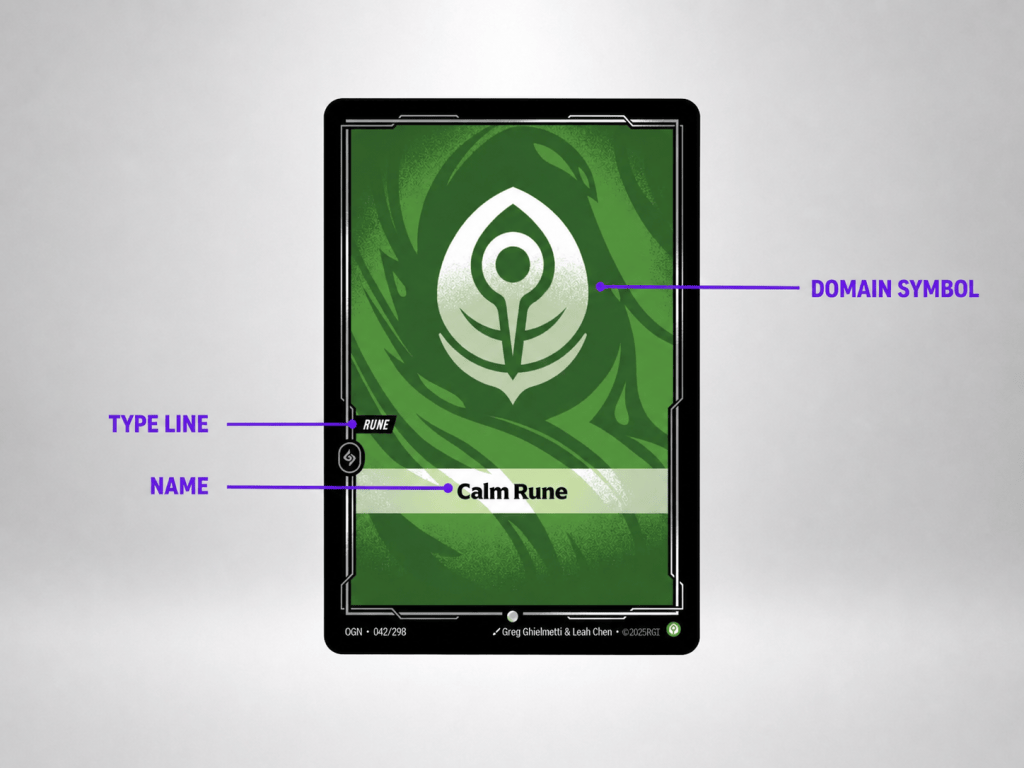
Rune card elements
| Element | What it means |
|---|---|
| Domain Symbol | The large domain symbol filling the centre of the card identifies which Domain this rune belongs to and what type of Power it produces when used. |
| Type Line | The small banner reading RUNE in the lower left area of the card. |
| Name | Appears in the text bar near the bottom. The name tells you which Domain the rune belongs to: Calm Rune, Fury Rune, Mind Rune, and so on. |
| No Cost box | Runes have no Cost. They are not played by paying Energy and Power. They are channelled as a specific game action at the start of your turn. |
| No Might value | Runes have no Might and cannot fight. |
| Rules Text | All basic runes have two abilities: exhaust to add 1 Energy, or Recycle this rune to add 1 Power of this rune’s Domain. These abilities do not appear on the basic rune card face but are part of the rules for all basic runes. |
Six basic rune types exist, one for each Domain: Fury Rune, Calm Rune, Mind Rune, Body Rune, Chaos Rune, and Order Rune. Non-basic runes also exist with additional abilities but always produce the same types of resources.
Token Cards
Token cards appear during gameplay when card abilities create them. They are not part of any deck and cannot be added to a deck. Physical token cards are included in Riftbound booster packs to represent tokens on the board, but you can use any object in their place.
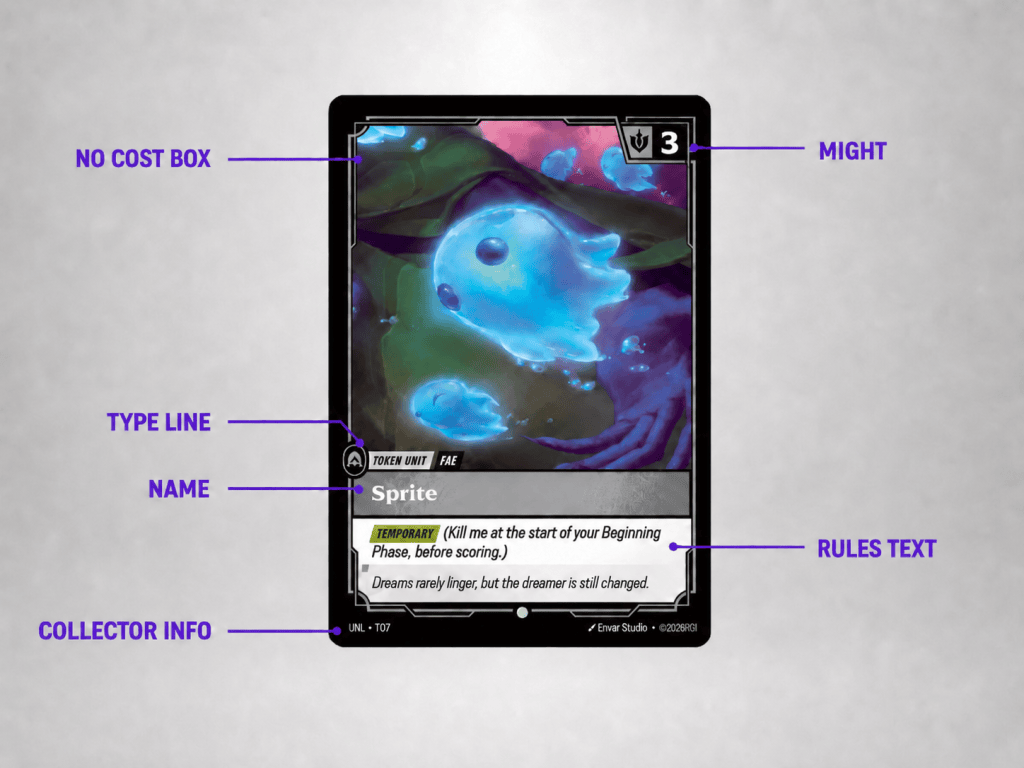
Token cards look similar to unit cards but have key differences. The card that creates a token describes its type, name, and Might.
| Element | What it means on a Token |
|---|---|
| No Cost box | Tokens are not played from hand and have no Energy or Power cost. The upper left corner where a cost box would appear is empty. |
| Might | Appears in the upper right corner, same as a standard unit. Tokens can fight and be killed by damage. |
| Type Line | Shows “Token Unit” or similar. “Token” is a supertype that appears before the card type. |
| Name | Describes the token type, for example: Sprite, or a character name for named tokens. |
| Rules Text | Any abilities the token has while it is in play. Some tokens have keywords or special rules. |
| Collector Info | The collector number on a token card is prefixed with T (for example, UNL T07). The T prefix identifies this as a token-type card, not a Main Deck card. |
For a visual reference of every token card in Riftbound including Unleashed tokens, see the Riftbound Token Cards page.
Buff Cards
Buff cards appear during gameplay when card abilities attach them to units. Like Token cards, they are not part of any deck and cannot be added to a deck.

A Buff card is attached to a unit by a card ability. While attached it grants that unit the Might Bonus printed in the upper right corner. A unit may only have one buff attached at a time.
| Element | What it means on a Buff card |
|---|---|
| Name | Printed in the upper left. All standard buff cards share the name “Buff.” |
| Might Bonus | Shown as “+N” in the upper right corner with a domain symbol next to it. While this Buff is attached to a unit, that number is added to the unit’s Might. The domain symbol indicates the buff’s domain. |
| Rules Text | The text box in the lower half of the card. On the standard Buff card this reads: “A unit may have no more than one buff at a time.” |
| No Cost box | Buff cards have no Cost. They are attached to units by ability effects, not played from hand. |
| Collector Info | The collector number is prefixed with T (for example, UNL T04), confirming this is a token-type card included in booster packs rather than a Main Deck card. |
XP Tracker Cards
The XP Tracker is a special non-deck card used to track a champion’s accumulated XP during the game. It is not played from hand and is not part of any deck.

The XP Tracker card enters play alongside a Champion unit that has the Level keyword. XP is marked on the tracker as the champion earns it. Some cards gain bonuses based on the amount of XP tracked, and some can spend XP for powerful effects.
| Element | What it means on an XP Tracker |
|---|---|
| Name | Printed in the upper left. Identifies this as the XP Tracker. |
| Rules Text | Explains the function of the card: track gained XP here. Reminds you that some cards get bonuses based on XP and some cards can spend XP. |
| No Cost box | XP Tracker cards are not played from hand and have no Energy or Power cost. |
| Collector Info | Prefixed with T (for example, UNL T08), confirming this is a token-type card included in booster packs. |
Showcase, Alternate Art, and Foil Cards
Some Riftbound cards come in showcase, alternate art, or foil versions with different artwork, different border treatment, or extended full-art layouts. These versions have identical gameplay rules to their standard counterparts. The only difference is visual. Rune cards also come in alternate art versions and the same rule applies. If you are unsure whether a card is a special version, check the collector number against the standard set size.
Card Designer Credit
Every Riftbound card carries the name of the card’s illustrator in small text in the bottom right corner of the card, next to the copyright notice. This credit has no gameplay significance but acknowledges the artist who created the card’s artwork. Riftbound cards are illustrated by a wide range of professional artists from across the world.
Quick Reference: Every Card Element
Use this table as a quick reference for riftbound card anatomy: every element in one place, with which card types they appear on.
| Element | Plain English meaning | Appears on |
|---|---|---|
| Energy Cost | The number in the upper left circle. How many Energy you need to play the card. | Units, Champions, Spells, Gear |
| Power Cost | Domain symbols stacked below the Energy number. Each symbol means 1 Power of that domain required to play. | Units, Champions, Spells, Gear (not always present) |
| Might | Upper right corner. The unit’s combat stat. Damage dealt in combat. Unit is killed when damage reaches this number. | Units, Champions, Tokens |
| Name | The card’s unique identifier, including any subtitle. | All cards |
| Type Line | What kind of card it is. Supertypes (Champion, Signature, Token) appear before the main type. Tags appear after. | All cards |
| Tags | Words after the card type. Link Champion units to their Legend. Referenced by abilities. | Units, Legends |
| Rules Text | What the card does. Contains abilities, keywords, reminder text, and activated abilities. | All cards (can be blank) |
| Effect Text | A visually separate block below the Rules Text. Only active when the card is Attached to a unit. | Gear cards (not always present) |
| Might Bonus (Gear) | “+N” in the lower right. Added to the Might of the unit this Gear is Attached to. | Gear cards (not always present) |
| Might Bonus (Buff) | “+N” in the upper right of a Buff card with a domain symbol. Added to the unit the Buff is attached to. One buff per unit maximum. | Buff cards |
| Domain Identity | Domain symbols in the upper left area of a Legend card. Determines which cards can be in your deck. | Legend cards |
| Domain | Domain symbols in the lower right corner. Must match your Legend’s Domain Identity for deck-building. | Most Main Deck cards |
| Flavor Text | Italicised text in a shaded bar. Decorative only. No gameplay effect. | Some cards |
| Collector number and set code | Bottom strip. Set code (UNL, ORI, SFD) plus card number out of set total. Token cards use a T prefix (T04, T07). No gameplay effect. | All cards |
| Card designer credit | Illustrator name in the bottom right corner next to the copyright notice. No gameplay effect. | All cards |
Go Further
Now that every element makes sense, here are natural next steps:
- Domain Symbols explained covers what each domain means and how they shape your deck.
- Riftbound Keyword Index A to Z gives the full meaning of every keyword you will see in the text box.
- How Damage Works in Riftbound explains exactly how Might and combat damage interact.
- Which Riftbound deck should I buy first? is a good stop if you are thinking about getting started.