Wondering whether to buy singles or booster packs?
Singles vs booster packs. Which is better value.
Every Riftbound rarity symbol is a small gem at the bottom centre of the card. The shape and colour of that gem tells you the rarity. The card’s frame colour and finish back it up. This page covers every rarity in Riftbound, how often each one appears in packs, and what it means for collecting and deck building.
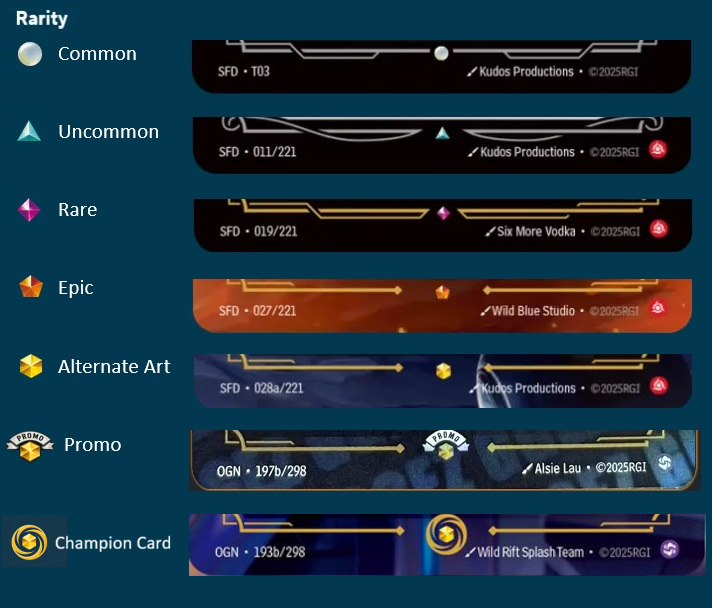
Riftbound card rarities: Common (circle), Uncommon (triangle), Rare (square), Epic (pentagon), Alternate Art/Ultimate rarity (hexagon), Promo (hexagon with promo stamp).
Some Alternate Art cards are also available as Signature versions, featuring a foil artist signature.
Promo cards exist for different rarities.
Ultimate Rarity is the rarest card rarity in Riftbound, appearing in fewer than 1 in 1,000 packs. Riftbound’s first Ultimate Rare is a unique overnumbered card of the new Baron Nashor.
Currently this shares the yellow hexagon symbol.
Champion cards are awarded to the winners of regional competitions.
Promo cards exist for different rarities.
Common
Symbol: Round circle gem. Frame: Bronze border with clean hextech filigree.
Pull rate: Every pack contains 7 Common card slots. Commons are the most frequent cards you will open by a wide margin.
Deck building: Commons are the backbone of every Riftbound deck. They are simple, versatile, and designed to fill clear roles. You will run three copies of most Commons without hesitation, and they cost almost nothing to pick up as singles if you are missing any.
Uncommon
Symbol: Upward-pointing triangle gem. Frame: Silver border.
Pull rate: Every pack contains 3 Uncommon card slots. All Battlefield cards in Origins and Spiritforged are Uncommon, which Riot confirmed was a deliberate choice to keep them accessible.
Deck building: Uncommons sit a step above Commons in complexity, often rewarding specific synergies or narrower strategies. They are inexpensive as singles and safe to run at three copies. Because all Battlefields are Uncommon, you will need at least a few in every deck you build.
Rare
Symbol: Square gem. Frame: Gold full-art frame with foil pattern. All Rare cards are foil by default.
Pull rate: Every pack has 2 Rare-or-better card slots, so you are guaranteed at least 2 Rares per pack unless one or both upgrade to Epic.
Deck building: All Champion Legends are Rare. Riot made this choice deliberately so that the core card for any champion deck is never locked behind a high rarity wall. Rares are a moderate cost as singles and are widely available. Running three copies of key Legends is normal.
Epic
Symbol: Pentagon gem. Frame: Minimalist gold frame designed to show off the artwork, with foil treatment. All Epic cards are foil by default.
Pull rate: Epics appear in approximately 1 in every 4 packs. A typical 24-pack booster box produces around 6 Epics. When an Epic appears it replaces one of the Rare slots, so you can open two Epics in a single pack.
Deck building: Champion Units and Signature Spells are mostly Epic, making them the high-impact cards in any champion-focused deck. They are the most expensive functional rarity to buy as singles. Build your deck around Commons and Rares first, then add Epics as finishers or pivots once the core is working.
Ultimate Rarity
Ultimate Rarity is the rarest card rarity in Riftbound, appearing in under 0.1% of packs — fewer than 1 in every 1,000 opened. The symbol is a yellow hexagon. Riftbound’s first Ultimate Rare is Baron Nashor, which exists in multiple overnumbered versions — each with a collector number exceeding the set’s total card count of 219, confirming its status outside the standard print run. Ultimate Rarity will not appear in every future set; Riot has confirmed it is reserved for truly special cards.
Deck building: The Ultimate Rare Baron Nashor is a collector item first. A standard Epic version of Baron Nashor exists and plays identically. Build your deck around the Epic version and treat the Ultimate Rare as a long-term chase piece if collecting is your goal.
Alternate Art
Symbol: Gold hexagon gem. Frame: Enhanced foil treatment, usually featuring a different League of Legends skin artwork for that champion.
Pull rate: Alternate Art cards appear at roughly 2 per box across a 24-pack display, confirmed by Riot. They are distributed randomly with no guaranteed slot.
Deck building: Alternate Art cards are cosmetic upgrades to existing champion cards. They play identically to their standard versions and are legal in all formats. If you open one it is a bonus. Run the standard version in your deck and treat the Alternate Art as an upgrade if you prefer the artwork.
Overnumbered Cards
Overnumbered cards are premium versions of Champion Legends, illustrated by Riot’s own artists. Their collector number runs above the main set total. Origins has 298 cards in its main set, so Overnumbers start at 299/298. Spiritforged Overnumbers start at 222/221. Unleashed Overnumbers start at 220/219. That numbering is how you confirm at a glance whether a card is an Overnumber.
Pull rate: Overnumbered cards appear at roughly 1 per 3 boxes. Approximately 1 in 10 Overnumbers is a Signature Overnumber, featuring a foil artist signature, making those approximately 0.14% per pack.
Collecting: Riot has confirmed they will never reprint the same Overnumber with identical art and frame, keeping each one unique long-term. They play identically to their standard counterparts in all formats, with legality tied to the original set regardless of which set’s packs they appeared in.
To see what overnumbered and signature cards are worth on the secondary market, the Ahri collector guide covers every variant from $4 to $2,664.
Promo
Symbol: Hexagon gem with a PROMO stamp overlay instead of a standard rarity icon.
Promo cards are distributed outside of standard booster packs, typically through events, preorders, release events at local game stores, or organised play. They carry a PROMO stamp rather than a standard rarity gem. Promo cards exist across different rarities and retain the same gameplay text and format legality as their standard versions. The PROMO treatment is purely visual.
Champion Cards
Symbol: Gold circular emblem, distinct from all standard rarity gem shapes.
Champion cards are awarded to winners of regional competitions. They are not available in packs or through retail. They are among the rarest Riftbound cards in existence by design, and are legal to play in all tournament formats.
Rarity vs Card Finish: What Is the Difference?
This is one of the most common points of confusion when you are new to Riftbound. Rarity and card finish are not the same thing.
Rarity is how often a card appears in packs. It is shown by the gem shape and the frame colour. Common, Uncommon, Rare, Epic, and Ultimate are rarity classifications.
Card finish is the visual treatment on the card’s surface: standard (no shine), foil (a sheen across the card), and the enhanced UV and textured treatments found on Overnumbered cards.
The part that trips people up: all Rare and Epic cards are foil by default, but a foil card is not automatically Rare or Epic. Every pack includes a dedicated foil slot that can produce a foil Common or Uncommon. Opening a shiny card does not mean you pulled something powerful. Check the gem shape first, not the finish.
What Is in a Riftbound Booster Pack?
Every Riftbound booster pack follows this confirmed structure:
- 7 Common card slots
- 3 Uncommon card slots
- 2 Rare-or-better card slots (either slot can upgrade to Epic)
- 1 dedicated Foil slot (usually a Common or Uncommon foil, but can upgrade to Rare or Epic)
- 1 Token or Rune card slot
- 1 informational insert
The Token or Rune slot occasionally produces a foil Rune, and very rarely a special Alternate Art basic Rune. Worth a look before you set it aside.
Frequently Asked Questions
What is the rarest card in Riftbound?
The Ultimate Rare Baron Nashor from Unleashed, appearing in fewer than 1 in every 1,000 packs. Before Unleashed, Signature Overnumbered cards were the rarest pulls at approximately 0.14% per pack.
Does a foil card mean higher rarity?
Not automatically. All Rare and Epic cards are foil by default, but the dedicated foil slot in every pack can also produce a foil Common or Uncommon. Check the gem shape to confirm the rarity, not the finish.
Are Alternate Art cards a separate rarity?
No. Alternate Art cards are visual variants of existing champion cards, identified by a hexagonal gem. They play identically to their standard versions and are legal in all formats.
How many Epics should I expect from a booster box?
Around 6 Epics from a standard 24-pack display, based on the confirmed rate of approximately 1 Epic per 4 packs. Because Epics replace a Rare slot it is possible, though uncommon, to open two Epics in a single pack.
What does a card number higher than the set total mean?
It is an Overnumber or Ultimate Rare. For example, the Ultimate Rare Baron Nashor in Unleashed is numbered 238/219. That number being higher than 219 confirms it sits outside the standard print run and is not part of the main set for format legality purposes.
Do higher rarity cards win games?
Not automatically. Riftbound is designed so that Commons and Uncommons remain core to competitive play. Higher rarity signals complexity and impact, not a guaranteed power advantage. Some of the most important cards in competitive decks are Rares, not Epics.
For a full beginner’s guide to Riftbound covering rules, products, and deck building, visit RiftboundGuide.com. If you are ready to start your Unleashed collection, our Riftbound Unleashed products buying guide covers every product available at launch.